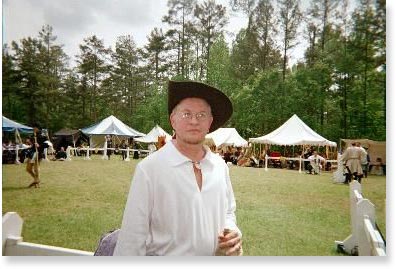
Karl von Lindenheim
Born in 1530 not far from Oberammergau (Germany), Karl had a reasonably happy childhood as the only son and heir to the modest estate of Lindenheim. A frail and bookish lad, he was doted on by his mother, Mathilde, but only grudgingly accepted by his father, Heinrich von Lindenheim. Mathilde, a devout Catholic, inculcated her own love of the Church into her young son.
This comfortable state of affairs was disrupted by the arrival of a pair of lusty twin baby boys when Karl was nine years of age. Predictably, the twins soon became the favorites of his father. When they grew older and were hurt in a fall down a flight of stairs, Heinrich placed the blame unfairly on Karl and determined to get rid of him, especially after bullying Mathilde into admitting that Karl was not truly his son.
Heinrich arranged for Karl to be sent away to the Italian city-state of Milan, where he was to be castrated (ostensibly in order to retain his soprano voice into adulthood, something that was just becoming stylish at that time and that later became very popular for opera singers), and then enrolled in a conservatory to study music and singing, in preparation for a career in the Church.
The unhappy boy resigned himself to his fate, but despite his best efforts, his voice turned out to be nothing exceptional. He did, however, develop a sinful attraction to the older boys and men, something that he strove mightily to suppress.
Some years later, word reached him that his mother had died, making his loneliness complete.
As his time at the conservatory drew to an end, he was noticed by Bishop Albertini, who was on his way to a new assignment at the cathedral in Florence. Drawn into an illicit liaison with His Excellency, Karl was promised a place as assistant choirmaster, if he would come to Florence. With some misgivings, but seeing no other likely possibilities, Karl accepted this offer.
During the next six years, Karl learned much about the reality of life in the Church. He experienced the good and holy as well as the evil and sordid.
As a result of being given a copy of an heretical book by an intriguing stranger, he became aware of the teachings of the Protestant Reformers of the time. He began to question not only his own Faith, but the efficacy of faith in general.
Disenchanted with his relationship with Bishop Albertini, he became enamoured of the attractive young organist at the cathedral. When they are discovered in flagrante delicto, the Bishop threw him out with only the clothes on his back.
Karl wandered the streets of Florence in despair, where he was set upon by robbers and left beaten and freezing in the winter night. He was felicitously discovered by the stranger who had given him the book that led to his fall from grace, one Vittorio Venanzi, who turned out to be the owner of a very exclusive brothel.
Vittorio took Karl home and initiated him into a life of luxury and sexual pleasures far beyond the wildest imaginings of our naïve, but sadly fallen, angel.
Karl went on to spend the better part of his young adult years with Vittorio, serving the exotic and varied pleasures of his wealthy clients, both male and female. As a castrato, he is somewhat of a novelty and greatly in demand.
Despite his rather inauspicious beginnings, Karl entered into the spirit of the Renaissance, becoming an enthusiastic scholar of the many new ideas that were sweeping through society.
As he matured, Karl and Vittorio became close friends and partners in various business transactions, sharing quite a few hair-raising adventures. By the time of the older man's tragic death in a duel, Karl had amassed a certain amount of money. Finding himself also a beneficiary of a goodly portion of Vittorio's wealth, he decided the time has come to return to his family home and find out what has transpired in the many years since his banishment. His mother died while he was at the conservatory, but, now bereft of Vittorio's friendship and guidance, he longed to re-visit Lindenheim and see if there was any chance for reconciliation with whatever remained of his family.
He returned home to find the estate in ruins.
Telling no one who he was, he made careful inquiry into what had transpired, discovering that his father was long dead, and his brothers, still living there in squalor, drank and gambled away the greatest part of their inheritance.
Through an intermediary, Karl purchased the property from them. Over the course of several years, he made Lindenheim into a going concern. Using many of the business tactics he learned from Vittorio, he brought in hard-working tenant farmers, rewarding them well for their efforts. He encouraged skilled woodworkers and craftsmen to locate on the estate and produce a line of quality goods, judiciously harvesting the forests for their projects. Whenever the opportunity arose, he went on to purchase more of the surrounding forestlands.
As a castrato, he can father no children, but he searched out his brothers' illegitimate offspring and found one of them worthy of being his heir, training the promising youngster in the management of the estate.
Now in his 50's, a ripe old age in those times, he is free to travel if he wishes, or sit at home in comfort and consider his long and varied life. Whenever the urge strikes him, he works at setting down his thoughts and memoirs.
Since his estate falls within the boundaries of the Shire of Cathanar in the Kingdom of Atlantia, that is where he can most often be found.
Back to Index Page