World Cultures II - Unit 5
World Cultures II ~ Unit 5 Notes

A13 ~ Pedro Cabral - (1467-1520) Cabral was a Portuguese nobleman, explorer, and navigator who was the first European to see Brazil on April 22, 1500.  He sighted land, claiming it for Portugal and naming it  "Island of the True Cross".  The colony served primarily to provide food to the mother country, and this explains why only Brazilians, of all the countries of South America primarily speak Portugese instead of Spanish.

B2 ~ Giovanni Boccaccio was an Italian novelist born in Paris in 1313.  He was one of the earliest humanists, and also a founder of the Renaissance.  His most famous work was the Decameron.  It is important that we learn about him today because he helped to start the Renaissance and became a model for the distinctively Italian writing style.

C2 ~ Tamerlane - At a young age he had a lot of courage and great military talents which gave him many followers. In 1371 he became the Chagatai leader.  In 1395 Tamerlane had succesfully defeated the Mongol Empire.  After going through Afghanistan in 1398 he went to India, which he captured.  He then went westward toward the Ottoman Turks.  In 1400 Tamerlane seized Aleppo with the use of war elephants he had captured in India.  Tamerlane moved on and captured Damascus and Baghdad.  In 1402 he captured the Ottoman ruler Bajazet.  After his death in 1405 his empire collapsed.

B3 ~ Geoffrey Chaucer - (1343-1400) - Geoffrey, a famous English poet, was born in London, the son of a vintner, John Chaucer.  At age fourteen he served as a page under Prince Lionel for many years.  Later in his life he visited Italy on many diplomatic missions and held quite a few official positions including the clerk of the king's works.  He died in 1400 and is buried at Westminster Abbey.  His poetry was largely based on French models, and his most famous work being the Canterbury Tales, in which several characters tell interesting stories while traveling together on a pilgrimage.

D4 ~ Jan and Hubert van Eyck - Jan van Eyck (1390's - 1441) was a Dutch painter who completed a total of fifteen paintings during his lifetime.  His most famous painting was Giovanni Arnolfini and His Bride.  He perfected the new style of oil painting during his time.  His older brother, Hubert van Eyck (1366 - 1426), was also a painter. Hubert started the famous Ghent Altarpiece, which was later finished by Jan after Hubert died.  On this altarpiece, he painted one of his most famous works, Adoration of the Lamb.  Together, the brothers worked on The Last Judgement and The Man in the Red Turban.

A7 ~ Louis IX ( the Pious) - He became king at the age of twelve.  In 1234 he married Margaret of Provence, whose sister was married to Henry III. He reformed taxation and the courts, so everyone regardless of status would have a fairer court.  He founded a hospital for the poor and the blind.  In his reign it was the time of building great Gothic cathedrals in France.  He fought in two crusades, which he lost.  In 1250 he was defeated at Mansurah and was taken prisoner.  He was released when the ransom was paid.  In 1270 he joined another crusade, and died on the trip from Typhoid fever.

D8 ~ Edward V, Richard III, Henry VII - Edward V was the king of England(1483).  He was the elder son of Edward IV and Elizabeth Woodville.  His father's death left the boy king the pawn of the conflicting ambitions of his paternal uncle, the duke of Gloucester (later Richard III) and his maternal uncle, Earl Rivers.  Gloucester had Rivers arrested and confined the king and the king's younger brother, Richard, duke of York, to the Tower of London.  The princes were declared illegimate and Gloucester took the throne.  The two children disappeared, most likely murdered.  Skeletons, thought to be those of the young princes, were unearthed in the tower in 1647.
                      (from the Columbia Encyclopedia, sixth edition)

A10 ~ Alexander Borgia became Pope Alexander VI, the most notorious pope in history.  He had seven children. He appointed his son and his mistress's brother as cardinals.  His biggest concerns were power, wealth, and women. By 1500 his  outragous behavior was well known and Cesare (his son) and Alexander were trying to poison Cardinal Corneto, but he switched the cups and Alexander died.  Another version of the story is that he died of pneumonia.

B10 ~ Cesare and Lucretia Borgia - were considered to be part of the first crime family.  Started by their grandfather, their goal was to create a powerful state that would eventually take over all of Italy.  Cesare (1476-1507), the son of Pope Alexander VI, became a cardinal at a young age and also was the Duke of Valencia. He took over as a military captain after his brother died.  His father became very ill and died; he no longer had his ties to the papal seat, causing his reign to end.  Lucretia (1480-1519), however, was not as well off.  She became the pawn of her brother and father's sucess.  Both arranged several marriages for her, only to boost their political status.  She is often viewed as a poisoner who killed off many of her family's opponents, but historical sources do not necessarily agree.

                               Cesare Borgia         Lucretia Borgia

C10~ Treaty of Tordesillas - In 1494 the Spanish and Portugese signed the Treaty of Tordesillas in the Spanish town of Tordesilla.  The treaty was agreed upon to clarify ownership of land in the New World.  Portugal only ended up with the territory of Brazil while Spain received much more land, since the country was more loyal to the Catholic church.

A11 ~ Lodovico Sforza - 1452-1508 Was one of the wealthiest and most powerful princes of Renaissance Italy, and was a member of the Sforza dynasty of Milan. He was a notable patron of the arts, and was well known as patron of Leonardo Da Vinci, and spent immense amounts of money to advance arts and science.  He was also the subject of Machiavelli's The Prince.   

D11 ~ Hieronymous Bosch - (1450-1516) - Hieronymous Bosch produced some of the most inventive fantasy paintings that have ever existed.  His works have fascinated viewers, but earlier in time it was assumed that his nefarious scenes were to simply amuse and entertain.  Although his nightmarish work was done in the late Middle Ages it stands alone for its period and has a timeless and modern quality.  Some examples of his works are The Garden of Earthly Delights, and Third Day of Creation.

A12~ Albrecht Durer-(1471-1528) "Perhaps the greatest German artist of the Renaissance era", was the first artist to paint a self portrait and landscape painting of a specific scene.  He was a major influence in European art development, and his work includes altarpieces, religious work, portraits, self portraits and copper engravings.  His woodcuts made it possible for many people to own some small work of art for themselves.

B12~ John Cabot (Giovanni Caboto)  set sail from Bristol, England on May 2, 1497.  Cabot's home town was Venice Italy, known for its ships and sailors.  He acquired cash for one of his voyages which was supposed to find a route to the spices and riches of the exotic Far East.  John also had a son named Sebastian, who also sought the glory of discovery and led an expedition on a search for the northwest passage to Cathay (China) in 1508.


C13 ~ Josquin des Pres- (1450-1521) was one of the most significant composers of the renaissance period.  He was in the court of King Rene of Anjou in 1475, in the Papal chapel from 1486 to 1495.  He was employed by the Duke of Ferrara from 1503 to 1504, then became a provost of Notre Dame until his death in 1521.

B14 ~ Jakob Fugger (1459-1525) was one of Renaissance wealthiest citizens.  His influence in royal circles continued to change even after his death.  Though he was not the founder of the German trade and banking dynasty that bore his name, Fugger made his name known by entering into a profitable financial contracts with the Holy Roman Empire that gave him landholdings and money-making concessions in mining and trade.

A14 ~ Johann Tetzel (1465 - 1519) was a Dominican friar and the Pope's master salesman.  He travelled from village to village with a brass-bound chest, a bag of printed receipts and an enormous cross draped with the papal banner.  In each town he sold "passports to Heaven," also called indulgences.  They were usually more popular with the peasants and poorer people, who often couldn't afford them.  It's believed that Martin Luther was inspired to write his 95 Theses because of his disagreement with Johann Tetzel's practices.

A15 ~ Bartolome De Las Casas (1484 - 1566) Las Casas was known as the Father of anti-racism and anti-imperialism.  He was responsible for the econmienda system, which was a repeal to the laws which permitted Indians to be worked in slave labor gangs.  Not only was Las Casas a 16th century advocate for the rights of the native people, he was a scholar, Spanish colonist, founder of a Utopian community, a priest, and the first bishop of Chiapas, Mexico.

A18 ~ Thomas Munzer - He lived from 1489-1525.  He began by following Martin Luther, but became a more radical German protestant reformer.  He started siding with the lower class, and promoted a new system in which everyone would share goods.  After the Peasants war in 1524, he took over the Muhlhausen town council, and started a communistic theocracy.  After the peasants were defeated, he was beheaded.  His views influenced the Anabaptists, even though he rejected baptism.

A19 ~ Huldreich Zwingli - As a young man he was a Catholic, but dreamt of a union that used simplicity, in which everyone lived off the land.  After studying Luther, and living through the plague, he became a reformer and broke away from the Catholic Church.  He then began to try to expand the reformation throughout Switzerland.  He had a great influence on the cities that were involved with the reformation (especially Zurich), but he was resisted when he tried to reorganize the government, under the ideas of Protestants.  Today, his beliefs are carried out in the style of that of the Protestant German Switzerland church.

C19 ~ Babar inherited the kingdom of Farghana from his father at age eleven.  Some historians suggest that the goverment Babar set up was saifi (by the sword) and not qalami (by the pen).  Babar's guns and his long-practiced use of the enveloping tactics of central Asian calvary helped him expand his empire.  Parts of the Empire, Central Asia; North India; and as far south as Gwalior and as far east as the Bihar, were ruled by ministers.  The chronicles of his life, the Babarnama, is still widely used.

A20 ~ Melanchthon, Philip(1497-1560) was a German scholar and humanist.  He was second only to Martin Luther as a figure in the Lutheran Reformation.  Melanchthon's influence on the Lutheran movement had many sides. He served as mediator between Luther and the humanists, tempering the Protestant disapproval of wordly culture. Luther had great confidence in Melanchthon as his successor, but Melanchthon was  ill-suited for leadership. Melanchthon is mainly known for his powerful role in creating the German schools, and is known as preceptor of Germany.
                 
                                                                 The image “http://www.famu.edu/acad/colleges/cas/histpol/eidahl/Spring/WOH1022/Images/Melanchthon1.jpg” cannot be displayed, because it contains errors.

B20 ~ Schmalkaldic League - an alliance formed in 1531 at Schmalkalden by Protestant princes and delegates of free cities.  It was created in response to the threat by Holy Roman Emperor Charles V to stamp out Lutheranism. Led by Philip of Hesse and John Frederick I of Sacony, the league grew rapidly(1530).  In an effort to crush the independence of the states of the empire and to restore unity to the Roman Catholic Church, Charles V initiated the so-called Schmalkaldic War against the League.  At the battle of Muhlberg, the League was defeated.

B21 ~ John Calvin was a French reformer and theologian who fled Catholic France to the free city of Strasbourg having recently converted to the "evangelical" faith and publishing The Institutes of the Christian Religion, which articulated his protestant views.  Calvin later sought asylum in Geneva, Switzerland, where he stayed for a good portion of his life.  The stronghold of Calvanism later became Scotland and Northern Ireland, thanks largely to the efforts of John Knox.  Calvin was the first reformer to stress the concept of predestination (that our lives are planned by God from our beginning), however his followers took this to a level that he never wanted it to go to.  Day to day, church bodies with the names "Presbyterian" or "Reformed" (and even some Baptist groups) carry forward his legacy in local parishes all over the world.

A22 ~ Madrigal - meaning: a poetic and musical  form of 14th century Italy, and a 16th or 17th century setting of secular verse. In the 1550s and 1560s four to six parts became the norm. The term "madrigal" came to be used for a verse owing its style, imagery, and vocabulary to Petrarch.

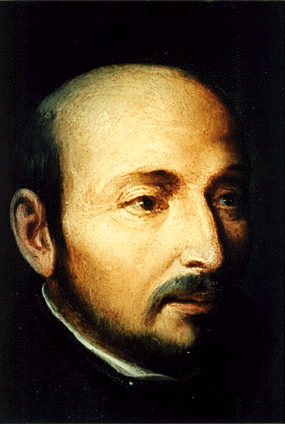
D22~ Ignatius Loyola - He was born in northern Spain in 1491.  Until about the age of 30 Ignatius lived a life filled with fighting, gambling, and fantasies of women.  Eventually he found himself reading about saints and Christianity while recovering from a battle wound.  A feeling of peace came over him after his conversion.  He even went on a Pilgrimage to the Holy Land.  Ignatius eventually returned to school to become a priest and wrote Spiritual Exercises, to teach others about Christianity.  Ignatius is most known for founding a group called the Society of Jesus, commonly known as the Jesuits.  Ignatius died in 1556 and we celebrate his feast day on July, 31.

St. Ignatius

C23~ John Knox - Was born around 1514 in Scotland.  He played a huge role in the reformation of the church in Scotland.  At the end of March 1543 he became committed to the Christian Gospel.  He was appointed  the preacher of St Andrews and his first sermon came from Daniel 7:24-25. The French took St Andrews and they made Knox an oarsmen. Despite his physical suffering his strength grew spiritually. After being released he went to England and became a minister of of the Church of England. After lots of moving around , he eventually made it back to Scotland.  He helped organize a National Reformed Church that began after Scotland was declared Protestant. John Knox preached his last sermon on November 9th, 1572, and a few days later he became ill. He died on November 24th of that same year.

A24 ~ Pope Paul III - was pope from October 12, 1534 to November 10, 1549 (15 years). He was the first pope of the Counter Reformation, and inaugurated the Council of Trent. Pope Paul III established the Index of Forbidden Books in order to sheild Catholics from heretical views. He also established the Congregation of the Roman Inquisition, officially known as the Holy Office.
 
C24~ Gerardus Mercator - Gerardus was born in Rupelmonde, Flanders on the second of March in 1512 and died at Duisburg at the age of 82 in 1594. At the age of 24 he became famous for his first terrstrial globe and from then on out he was known as the foremost geographer of his time. The famous globe that he gave us was the Mercator Projection  in which engravings were made on a solid sphere  represinting all of earth geological features known to man at this time. The globe also had parallel lines that would space out further and further from the equator and prime meridian to show longitude and latitude. ALthough he was famous for many other things such as maps of citys and completions of Ptloemys maps it was his projection globe that set him apart from every other geographer of his time.

A25 ~ Francis Xavier was a Spanish Jesuit missionary who helped to change the way of life in Asia.  He vigorously spread the Gospel in India and helped the Portuguese return to the practice of their religion.  Using a placid and enjoyable method of instruction, he was able to teach men and women of all ages the Ten Commnadments, the Lord's Prayer, and the Hail Mary.  By the time Francis was ready to leave India, Jesuits had already developed sixteen major villages along the coast.  After arriving in Japan, he and his followers began to spread the word of God in a land where Buddhism and Shinotoism  were the central religions.  He was able to assist two hundred thousand Japanese people to embrace Christianity, and became a Saint of the Catholic Church because of it.

D25 ~ Peace of Augsburg - (1555) - The peace of Augsburg was the first legal basis, within the Holy Roman Empire, where each prince was to determine wheter Lutheranism or Roman Catholicism was to prevail in that land.  Citizens in those areas who disagreed with the decision were permitted to emigrate to a new land.  Free cities were obligated to acquiesce to both Catholicism and Lutheranism.  The peace was proposed by Melanchthon.

A26 ~ Charles V inherited his kingdom from his father, Philip I, and his grandfather Ferdinand II.  After bribing the electors, he was chosen Holy Roman Emperor in succession to his grandfather.  During the rule of Charles, the Spanish Empire was greatly expanded in the New World.  In Italy, Spanish power had become paramount. Even England seemed ready to fall to Spain through Philip's arranged marriage.  Also, Charles's marriage to Isabelle of Portugal brought the Portuguese crown to Philip in 1580.  However, Charles failed at his attempt to return the Protestants to the Roman Catholic Church, and the hunan and financial cost of continuous warfare drained Spanish resources.  Moreover, Charles's hopes of a universal empire were crushed by the political realities of Western Europe. ( from The Columbia Encyclopedia, sixth edition)  Charles, distressed by his political failures, eventually abdicated his throne in favor of Philip (II).

B26 - Phillip II of Spain -The first king of Spain, as it is understood to mean the whole peninsula of Hispana.  He was the self proclaimed leader of the Counter-Reformation, and destroyed the greatest Navy in the world (his own) when he sent his Armada against the English.

A27 ~ Andrea Amati - He made violins in the 16th century which were all mostly in sets.  The most famous of these is a set of instruments he made during the 1560's and 1570's for the court of Charles IV in France.  The violin as a concert instrument was used through out Europe during  the 16th and early 17th centuries for dance music and polyphonic compositions.

B27 ~ Oda Nobunaga - (1534-1582) major daimyo, a powerful feudal leader.  He was a great war strategist, good business man and good at economics.  He was very intersted in European culture (a new thing in Japan at that time). Patron of the Jesuit missionaries in Japan, he did not convert to Christianity.  He worked toward unifying Japan, but was then forced to commit suicide by one of his generals.


C28 ~ Walter Raleigh (1554 – 1618) – a favorite of Queen Elizabeth I, was prominent in the royal court and was the captain of the army of Ireland. Before he led expeditions to North America and South America, he attended Oxford and studied law. After which, he wrote many books: History of the World and Discovery of Guinea. He is famously known for establishing colonies on Roanoke Island on two separate occasions (1585 and 1587).

Sir Walter Raleigh is important today because he had a great impact on Renaissance society. He was known as a Renaissance man and others copied him in hopes of being like him. He, also, made it easier for future explorers to colonize North America.


Return to our Coursework Resources Page.

Return to the Homepage

livedEÑ m