Valid HTML 4.01 Transitional Affirm individual human rights

Consciousness, Physics, and the Holographic Paradigm

Essays by A.T. Williams

Part I:  Sneaking Up On Einstein

All matter is immersed in it and it penetrates everywhere. No doors are closed to ether.
- Albert Einstein, The Evolution of Physics

rule01

Section 1 Section 2 Section 3 Section 4 Section 5 Section 6

Chapter 3

Section 2:  Beyond Mechanical Paradigms:
From Old to New Physics, Part 1

Based on the new kinematics they developed to describe the dynamic motion of the accelerated, electrically charged material particles that generate electric and magnetic fields, and unaware of the massless electromagnetic spectrum that was yet to be discovered, the collaborative team of Albert Einstein and his learned first wife, Mileva Marić (pronounced Marich) – who was his classmate and independent study partner at the ETH in Zürich – excluded from their special theory of relativity the luminiferous ether postulated by Christiaan Huygens, Thomas Young, James Clerk Maxwell, and Hendrick A. Lorentz, among others.

But the excluded luminiferous aether had served as the carrier of Maxwell's electromagnetic radiation. And massless nonmaterial electromagnetic radiation is comprised of the uninterrupted movement from point A to point B – regardless of distance – of the uncountable number of discrete massless photons (nonmaterial primordial energy quanta) of various values that constitute the comprehensive electromagnetic spectrum at any given instant of time. The innumerable photons are ostensibly emitted and absorbed by the particulate matter carriers of electric charge.

One consequence of an absent material or nonmaterial carrier of electromagnetic (em) radiation in the 1905 special theory of relativity (SRT) is the inescapable irony that the ubiquitous electric and magnetic fields generated by the particulate matter carriers of electric charge were soon treated as the de facto carrier of massless nonmaterial em radiation in classical mechanical/geometric physics and, later, in early classical quantum mechanics.

The demise of mechanical process in electromagnetic theory began with the first 1905 Einstein-Marić paper, On a Heuristic Viewpoint Concerning the Production and Transformation of Light, which contains the original theoretical description of the quantum nature of monochromatic light. Their revolutionary hypothesis is the historical source of the pre-1920s old quantum physics.

The extension of Max Planck's quantum energy concept through its application to visible light by means of the photoelectric effect also revived the 17th century wave-particle controversy between Christiaan Huygens' wave theory and Isaac Newton's corpuscles (material particles) of light.

The photoelectric effect:

James Clerk Maxwell, following the British custom of the time while intent upon adhering to mechanical Newtonian physics despite theoretical concepts and experimental findings by Michael Faraday to the contrary, chose to emphasize the similarities of Newtonian mechanics and the new physics of electric and magnetic energy by formulating a dynamical electromagnetic field theory that included fanciful mechanical analogies.

Several decades later the Einstein-Marić team pointed directly to a crucial distinction between classical Newtonian physics and Maxwell's dynamical theory of the electromagnetic field (nonmaterial radiative em energy) in the first paragraph of their 9 June 1905 photoelectric effect paper:

    According to Maxwell's theory, energy is to be considered as a continuous spatial function for all purely electromagnetic phenomena, hence also for light, while according to the current conceptions of physicists the energy of a ponderable body is to be described as a sum extending over the atoms and electrons. The energy of a ponderable body cannot be broken up into arbitrarily many, arbitrarily small parts, while according to Maxwell's theory (or, more generally, according to any wave theory) the energy of a light ray emitted from a point source of light spreads continuously over a steadily increasing volume.12

The crucial difference between mechanical kinetic energy and weightless, nonmechanical em radiation was accurately stated but poorly understood at the beginning of the 20th century not only by the Einstein-Marić team, but also by the physics community at large which was deeply immersed in the investigation of thermodynamics.

Incorporating Max Planck's intuitive discovery of the thermodynamic blackbody quantum of nonmaterial em radiation energy in the description of their own revolutionary work, the Einsteins' "ponderable body" quoted above is the electron ejected by the photoelectric effect following the application of quantized em radiation in the visible region of the em spectrum. Thus the energy of ponderable body under consideration is kinetic energy. Nonmaterial electromagnetic radiation and kinetic mechanical energy are separate and distinct phenomena.

Just four years after the 1905 photoelectric effect and SRT papers were published Einstein described the nonmechanical evolution of electromagnetic theory in his 21 September 1909 lecture at the Salzburg Conference:

The more electromagnetic theory advanced, the more the question of whether electromagnetic processes can be reduced to mechanical ones retreated into the background; one became used to considering the concepts of electric and magnetic field strength, electric space density, etc., as elementary concepts that are not in need of mechanistic interpretation. 13

The Universal Principle of Energy (TUPE):

Interestingly, nearly a century after the publication of the photoelectric effect, SRT, and the Salzburg lecture the unexpected discovery of the universal principle of energy (TUPE) in the zeroth year of the 21st century not only reveals the existence of the omnipresent, pervasive, nonmaterial primordial energy domain (NED), TUPE also reveals that material mass is a discrete, organized aggregation (change of state, phase transition) of fundamental, irreducible nonmaterial primordial energy (NPE) that is created within the NED.

Moreover, TUPE implies that relativistic invariant electric charge is much more than simply a traditional property of matter/mass and can now be seen as a natural, physically real nonmaterial phenomenon that is created concurrently (simultaneously) with material matter/mass in the NED. Indeed, the fundamental point-like unit of NPE called electric charge seems to serve as the indispensable link, the sine qua non between the material domain of matter/mass and the NED.

Succinctly put, the novel first law of the universal principle of energy (TUPE) states:

Fundamental, irreducible primordial energy exists in the absence of matter,
but matter is entirely dependent upon primordial energy
and cannot exist in the absence of energy.

Thus, the universal principle of energy (TUPE) implies that:

  1. Each instance of matter/mass and electric charge is a discrete, conditionally relative localized state (change of state, physical phase) of fundamental, irreducible nonmaterial primordial energy (NPE).
  2. Particulate matter/mass is created, contained, and maintained within the omnipresent, pervasive, nonmaterial primordial energy domain (NED).
  3. Electric charge is created, contained, and maintained conjointly (simultaneously) with particulate matter/mass in the omnipresent, pervasive NED.
  4. The NED is the carrier of particulate matter/mass.
  5. Particulate matter/mass is the carrier of electric charge.
  6. The NED is the carrier of the massless nonmaterial electric fields, magnetic fields, and photons generated by discrete, accelerated particulate matter in the material domain that has a positive (+) or negative (-) electric charge.
  7. In principle our holonomic material universe is a complex open (mechanically nonconservative) nonmaterial/material system wholly embedded within the fundamental, irreducible NED.
    • Complex open nonmaterial/material systems are mechanically nonconservative systems in which matter/mass and electric charge are created and destroyed as a separate and distinct coupled pair.
  8. The equivalence of relativistic mass and the rest energy of classical physics is valid only in a theoretically closed or isolated (mechanically conservative) material system.
  9. Global mass-energy equivalence is neither valid nor sufficient in a complex open (mechanically nonconservative) nonmaterial/material system.
  10. The paradoxical contradictions inherent in the wave-particle duality concept of classical physics and classical quantum mechanics are completely resolved within the omnipresent, pervasive NED by the identical nature (irreducible sameness) of matter/mass and fundamental, irreducible, nonmaterial primordial energy (NPE).
  11. So-called empty space is simply the conspicuous panoptic obverse of the massless omnipresent, pervasive NED.

More broadly, the universal principle of energy (TUPE) points beyond classical physics, beyond classical quantum physics and the material domain to nonmaterial primordial energy (NPE) and the nonmaterial primordial energy domain (NED) that produces discrete, conditionally relative nonmaterial energy states that include the unique, physically separate localized states of electric charge and material matter/mass, respectively.

Hence, the propagation of massless electric and magnetic fields and electromagnetic radiation is somewhat more complex than either the mechanical generation of nonmaterial em fields by changes in the positive (+) or negative (-) accelerations (changes in velocity) of electrically charged particles of various sizes, or the propagation of em radiation from point A to point B through so-called empty space (i.e., the NED).

So-called empty space is a nonmaterial optical illusion (visual misrepresentation) created by the discontinuous pattern, the irregular presence or absence of visible macroscopic particulate matter/mass within the omnipresent, pervasive, nonmaterial energy domain (NED). In other words, "empty space" has no separate physical reality. Nonetheless, it is sometimes exemplified by ad hoc concepts like the luminiferous ether the Einsteins' excluded from SRT, vacuum energy, quantum foam, or the Dirac sea, for example.

Intangible "empty" space that contains no visible, tangible matter/mass is simply the conspicuous panoptic obverse of the fundamental, irreducible, nonmaterial primordial energy domain (NED).

Electromagnetic radiation and the water wave analogy:

The fundamental tone of electromagnetic theory and practice was set for nearly one hundred years by the third paragraph of the Einstein-Marić 1905 photoelectric effect paper:

    According to the assumption to be contemplated here, when a light ray is spreading from a point, the energy is not distributed continuously over ever-increasing spaces, but consists of a finite number of energy quanta that are localized in points in space, move without dividing, and can be absorbed or generated only as a whole.14

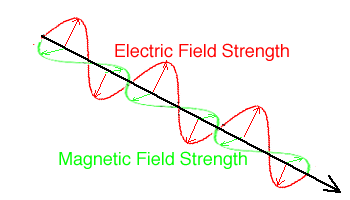
The traditional water wave analogy of Huygens, Young, and Maxwell, et al., offers certain similarities with respect to the propagation of visible light produced by a point source and classical water waves created on the calm surface of a pond or pool of water when a small stone is lobbed into it. Hence the transverse (lateral, orthogonal) electric and magnetic (em) fields of each massless monochromatic photon can be seen as analogous to the rising and falling waves on the surface of the water that transversely (radially) move away from the central point of entry.

Thomas Young (1773-1829), a polymath and medical doctor, was appointed in 1801 as the first professor of natural philosophy (physics) at the recently organized Royal Institution of Great Britain in London, England. Young dramatically improved the water wave analogy of Christiaan Huygens by simultaneously dropping two pebbles of equal size into a calm pond of water to demonstrate the phenomenon of wave interference. Augustin-Jean Fresnel (pronounced fray-Nell) further improved Huygens' principle in 1818.

Young demonstrated wave interference in his public lectures by using a novel two-slit teaching device. In the published version of lecture Thirty-nine, On the Nature of Light and Colours, he wrote:

    Supposing the light of any given colour to consist of undulations, of a given breadth, or of a given frequency, it follows that these undulations must be liable to those effects which we have already examined in the case of the waves of water, and the pulses of sound. It has been shown that two equal series of waves, proceeding from centres near each other, may be seen to destroy each other's effects at certain points, and at other points to redouble them; and the beating of two sounds has been explained from a similar interference. We are now to apply the same principles to the alternate union and extinction of colours.  (Plate XX. Fig. 267 [see woodcut diagram below])

    In order that the effects of two portions of light may be thus combined, it is necessary that they be derived from the same origin, and that they arrive at the same point by different paths, in directions not much deviating from each other. This deviation may be produced in one or both of the portions by diffraction, by reflection, by refraction, or by any of these effects combined; but the simplest case appears to be, when a beam of homogeneous light falls on a screen in which there are two very small holes or slits, which may be considered as centres of divergence, from whence the light is diffracted in every direction. In this case, when the two newly formed beams are received on a surface placed so as to intercept them, their light is divided by dark stripes into portions nearly equal, but becoming wider as the surface is more remote from the apertures, so as to subtend very nearly equal angles from the aperatures at all distances, and wider also in the same proportion as the aperatures are closer to each other. The middle of the two portions is always light, and the bright stripes on each side are at such distances, that the light, coming to them from one of the aperatures, must have passed through a longer space than that which comes from the other, by an interval which is equal to the breadth of one, two, three, or more of the supposed undulations, while the intervening dark spaces correspond to the difference of half a supposed undulation, of one and a half, of two and a half, or more. 15

(Note: A minor typo in the original text was corrected in Paragraph 1 above.)

Plate XX. Fig. 267, a woodcut diagram:

Young diffraction 16

Putting the importance of wave interference aside, applying the mechanical water wave analogy to massless em radiation and photon propagation breaks down at this point by focusing attention on the transverse waves rather than on the object or photon that creates the transverse waves. Clearly the rising and falling transverse waves created in a water or nonmaterial primordial energy (NPE) medium are a secondary effect.

In other words, it is the material object entering the water that creates the transverse waves on the plane surface of the water medium. And, by sinking vertically straight to the bottom, the material object is analogous to the discrete energetic photon that creates monochromatic transverse waves of electromagnetic radiation as it propagates from emission point A to absorption point B through the nonmaterial primordial energy domain (NED) regardless of the distance traveled.

Following the universal principle of energy (TUPE), a photon is a discrete, conditionally relative physical aggregation (change of state, phase transition) of NPE with the value rather than a material particle that possesses matter/mass.

EMR propagation

Contemporary double-slit experiments use a variety of methods and objects of interest such as photons and electrons. Furthermore, in contemporary classical physics and classical quantum physics the results of double-slit experiments like those of Akira Tonomura, et al., Hitachi Ltd, Japan, for example, are traditionally understood as demonstrations of wave-particle duality.

Beyond the classical and quantum mechanical paradigms:

The first law of the universal principle of primordial energy (TUPE) states that fundamental, irreducible nonmaterial primordial energy (NPE) exists in the absence of matter, but matter is entirely dependent upon NPE and cannot exist in the absence of NPE. The first law of nonmaterial primordial energy (NPE), therefore, implies the identical nature of material matter/mass and NPE within the fundamental, irreducible, nonmaterial primordial energy domain (NED) of physical reality just-as-it-is.

It follows that material matter/mass is fundamentally a discrete, organized aggregation (change of state, phase transition) of NPE within the irreducible nonmaterial primordial energy domain (NED). Hence, physical reality just-as-it-is is a complex open (mechanically nonconservative) nonmaterial/material system as opposed to a closed or isolated (mechanically conservative) material system.

Classical physics is fundamentally the history of classical mechanics. Classical mechanics, in turn, was extended into the microscopic realm by quantum mechanics. Nonetheless, while contemporary classical and quantum physics are valid in closed or isolated (mechanically conservative) material systems, classical and quantum mechanics are separately and collectively insufficient for describing the new physics of the complex open (mechanically nonconservative) nonmaterial/material nonmaterial primordial energy domain (NED) implied by TUPE.

Quantum physics continues to be a work in progress, thus there are many interpretations of quantum mechanics. Moreover, despite the constraints of the mechanical paradigm and the matter argument, the advancement in quantum theory and practice since the 1920s has trended in the general direction of the NED, especially in the areas of vacuum energy; dark energy, vacuum polarization, virtual particles, and self-energy.

Briefly summarizing the history of contemporary physics, Isaac Newton's physics and Christiaan Huygens' light waves in the late 17th century were mechanical. James Clerk Maxwell's mid-19th century physics and electromagnetic waves were mechanical. Max Planck's intuitive discovery of the thermodynamic blackbody radiation energy quantum of action in the zeroth year of the 20th century was the unexpected, unrecognized harbinger of nonmechanical, nonmaterial quantum physics.

Louis de Broglie (pronounced "de Broy"), after serving in the French army during WWI, postulated the wave nature of electrons in his 1924 doctoral thesis. Erwin Schrödinger published a series of four papers in 1926 in which the third paper proved that his particle wave mechanics were precisely equivalent to Heisenberg's 1925 matrix mechanics. In the fourth paper he developed a particulate matter wave mechanics equation that changes with time based on the conservation of nonrelativistic mechanical energy. The results of the contemporary relativistic Schrödinger equation are also limited to the material domain.

In 1927 Werner Heisenberg developed the uncertainty principle that defines the inherent inability of quantum mechanics to precisely measure the position and momentum of a material particle simultaneously. Heisenberg's uncertainty principle was later extended to include the inability of quantum mechanics to simultaneously measure kinetic energy and time with precision.

Interestingly, Heisenberg's uncertainty principle delimits only the classical and quantum mechanical material domains. Furthermore, the scope of physics and human understanding of physical reality just-as-it-is will undoubtedly be immeasurably increased by the new physics derived from the universal principle of nonmaterial primordial energy (TUPE) and the The Energetic Holographic Paradigm (TEHP).

Continued in Chapter 3, Section 3:  Particle Self-Energy and the Transition Zone:  From Old to New Physics, Part 2

rule01

Reference Notes (Click on the Note number to return to the text):

12  Einstein, Albert. On a Heuristic Point of View Concerning the Production and Transformation of Light. Anna Beck, translator. The Collected Papers of Albert Einstein; Vol. 2, Doc. 14, p. 86. Princeton University Press, Princeton, New Jersey, 1989. ISBN 0-691-08549-8

13  Einstein, Albert. On the Development of Our Views Concerning the Nature and Constitution of Radiation. Ref. 12, Doc. 60, p. 380.
(Cf. "Über die Entwickelung unserer Anschauungen über das Wesen und die Konstitution der Strahlung", Deutsche Physikalische Gesellschaft, Verhandlungen 7 (1909).)

The quoted text in the original German:

Je mehr sich die elektromagnetische Theorie entwickelte, desto mehr trat die Frage, ob sich die elektromagnetischen Vorgänge auf mechanische zurückführen lassen, in den Hintergrund; man gewöhnte sich daran, die Begriffe elektrische und magnetische Feldstärke, elektrische Raumdichte usw. als elementare Begriffe zu behandeln, die einer mechanischen Interpretation nicht bedürfen.

14  Ref. 12, p. 87.

15  Young, Thomas. Thomas Young's Lectures on Natural Philosophy and the Mechanical Arts, 1807. Reprinted in vol. 1, pp. 464-465: Thoemmes Press, Bristol, England, 2002.  4 Volumes:  ISBN 1 85506 945 8

16  Ref. 15, vol. 2, p. 777, Figure 267.

rule01

Back to Chapter 3, Section 1:  Einstein, Maxwell, and Energy

Index:  Consciousness, Physics, and the Holographic Paradigm

Last Edit:  August 22, 2009.

Comments and suggestions welcome.

This paper is a work in progress.
Please check for the latest update before quoting in other venues the concepts and hypotheses presented here.
Thank you.

eMail

Copyright © 2004-2009 by Alan T. Williams. All rights reserved.